

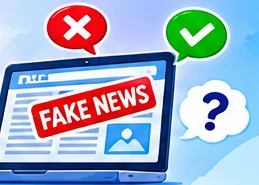
Fake News: How to Spot It Before You Share
False stories spread faster than the truth. Thirty seconds of checking can stop them with you.
 Class 6 to 10
 9 min read
 5 sections
Story time
 Story time
Kabir gets a forward: “Crocodile in our city! SHARE NOW!” with a scary photo. Riya gasps. In class, Ms. Rao shows them how to check the source, look for facts and check the date. A quick fact-check proves the photo is from another country. “Check, think, verify,” says Riya, “and only then share.”
Key words
 Key words
Read these words first. They will help you understand the article.


1What is fake news?Part 1 of 3
Fake news is false or misleading information made to look like real news. It might be a made-up WhatsApp forward, an old photo with a new caption, a fake “government notice” or an edited video. Some people share it by mistake; others create it on purpose.
1What is fake news?Part 2 of 3
Misinformation
- False, but shared by mistake
- The sharer believes it
- Example: a wrong home remedy forwarded by an aunt
Disinformation
- False, and spread on purpose
- Made to trick, scare or earn money
- Example: a fake notice to make people click a link
1What is fake news?Part 3 of 3
2Why fake news spreads so fast
 Why fake news spreads so fast
 Feelings
 Trust
Fake stories are often designed to grab attention. Real news can be slow and careful; a fake story can say anything. That's why the best defence is a pause before you share.
3The SIFT checkPart 1 of 2
- 1StopNotice how it makes you feel. Strong feelings are a signal to slow down.
- 2InvestigateWho made this? Is it a known news site, an official account or a stranger?
- 3Find othersDo trusted news sites or official pages say the same thing?
- 4Trace itFind the original photo, video or report. Is it old or out of context?
 1
 2
3The SIFT checkPart 2 of 2
4Edited photos and deepfakesPart 1 of 2
 Edited photos and deepfakes
Pictures and videos feel like proof, but they can be edited, cropped, taken from another country or year, or completely generated by AI. A deepfake can make a real person seem to say things they never said.
Do
- Do a reverse image search to see where a photo first appeared
- Look for odd details: blurred edges, strange hands, mismatched shadows
- Check official websites for “government notices”
Don’t
- Trust a video just because it looks real
- Forward “share before it's deleted!” messages
- Click links in messages promising prizes or free data
4Edited photos and deepfakesPart 2 of 2
5To share or not to share?Part 1 of 2
 To share or not to share?
 Official school notice
 Health “cure”
 Prize links
5To share or not to share?Part 2 of 2
A class group message says: “Schools closed tomorrow because of heavy rain! Official!” There is no link and no name.
Can't check it? Don't forward it as fact. A polite reply works: “I haven't found a reliable source for this yet.” And if you shared something false by mistake, post a correction and ask people not to rely on it. That's what responsible sharers do.
Quick summary
 Quick summary
- Misinformation is shared by mistake; disinformation is spread on purpose.
- Fake stories use strong feelings and speed, so pause before you share.
- Use SIFT: Stop, Investigate the source, Find other coverage, Trace the original.
- Photos and videos can be edited or made by AI; reverse image search helps.
- When in doubt, don't forward. Check official sources first.

Remember: Stop. Check the source and the evidence. Then decide whether to share.
Think and discuss
Talk about it
 Talk about it
- Why did the crocodile post make Kabir want to share it quickly?
- Which source would you check for a school holiday announcement?
- How can you correct a false message politely in a group chat?
Quick check
 Quick check
- What is the difference between misinformation and disinformation?
- Name three checks you can make before sharing.
- What should you do if you cannot verify a message?
Your teacher gives you made-up headlines (no real scary rumours). Sort them into “checked”, “needs checking” and “no evidence”, and say what evidence you would look for each time.

Ready for the quiz?
6 questions, one at a time. Your first answer counts, so think before you tap!
Parent advice
A few minutes together at home makes this lesson stick.


Talk about it
Pick one forward from your own WhatsApp groups and check it together using SIFT. Admitting when you have shared something false shows your child that checking is normal, not embarrassing.
Try at home
Make a family rule: “We check before we forward.” For a week, every time someone wants to share a news-like message, they first find one trusted source that confirms it.
